
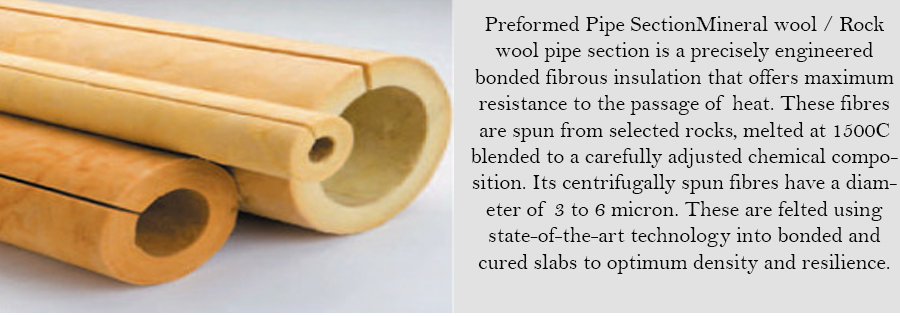
For refinery process piping and power station steam lines, optimizing heat retention is directly linked to fuel efficiency. Engineers use heat transfer formulas to select the correct insulation thickness.
Fourier's Law of Heat Conduction
The rate of heat loss (Q) through a cylindrical insulation shell is calculated as:
Q = 2 * π * k * L * (Ti - To) / ln(Ro / Ri)
Where:
- k (K-value): Thermal conductivity of the material (e.g. 0.034 W/mK for high-density rockwool at mean temp).
- Ti / To: Inner and outer surface temperatures of the pipe system.
- Ro / Ri: Outer and inner radii of the insulation layer.
Choosing rockwool with a low, calibrated K-value ensures that even under high process temperatures (500°C+), the outer jacket temperature remains below safe touch limits (usually 55°C), saving megawatts of fuel heat.
Need project-specific calculations or custom parameters?
Request Technical Support